
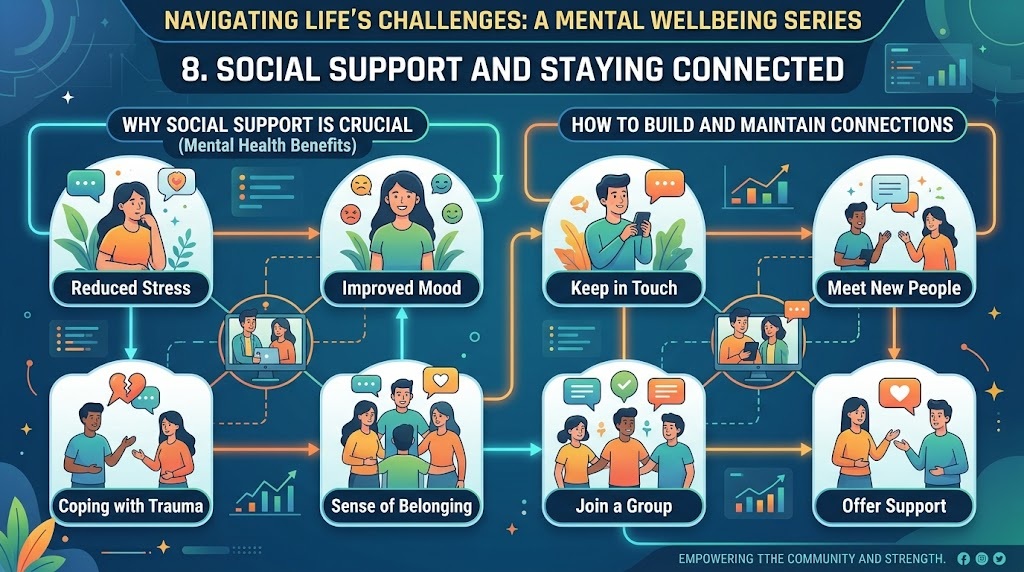
Supportive relationships are an important part of psychological wellbeing. During migration,
people may lose daily contact with family members, friends, colleagues, or familiar community
networks. Loneliness can increase stress and make ordinary challenges feel harder.
Connection does not always require a large social network. One trusted person can make a
meaningful difference. Try to maintain regular contact with family or friends, participate in
community activities, meet people through work, education, sports, volunteering, or cultural
activities, and allow yourself to ask for practical or emotional support when you need it.
It is also important to recognize that healthy relationships involve boundaries. You do not have
to share everything with everyone. Choose people who listen respectfully and make you feel
safe. Social support can complement but does not replace professional mental health care
when that is needed.
Practical Exercises
- Identify two people you could contact when you need support.
- Send one of them a short message or make a brief phone call this week.
- Identify one local place or activity where you could meet other people safely.
- Think about one person who may also need support and check in with them.
- Practice asking for help using a simple sentence: “I am having a difficult time and I would
like someone to listen.”